
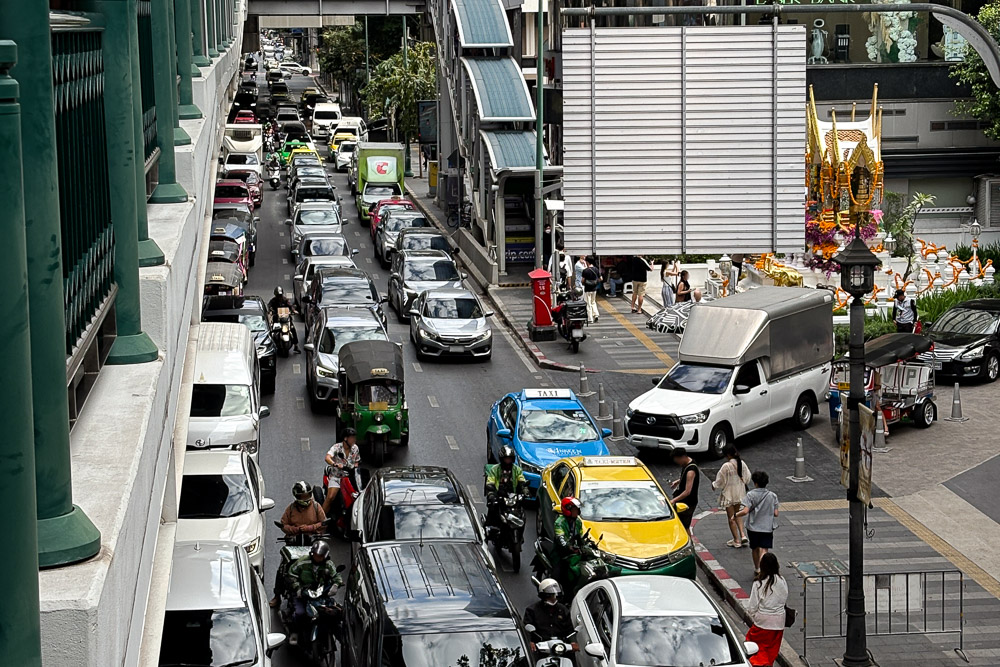
Having been to Bangkok or lived there, this question might have crossed your mind at one point when you are trying to cross the road.
In this article, we will try to list a few reasons why we, a Bangkok local and commuter, along with a few interviewed drivers of Bangkok, think are the main reasons.
*This article is not a research article; the main purpose is simply a sharing of perspective on a question. It is not claimed to be the true reasons or the correct reasons, merely a partial aspect of what may be. It is not meant to be used as a research tool for academic or any other purposes other than for curious tourists or locals who may simply be curious.
The Travel Knowledge Series,
Bangkok road-crossing culture,
Thailand
This article is a sequel to ‘How to cross the road in Bangkok: the local’s ‘trick’,’ and is aimed at providing more clarity and depth.
Introduction
Dear Readers,
Why do we not immediately stop for pedestrians? You may ask. Well, the reason may not be so simple. In this section, we will attempt to identify some problems from a local perspective for those who are interested.
Many of us actually do want to stop; however, the flow of our driving environment does not allow us to do so naturally. Bangkok does have a speed limit, 60km/h for most parts of Sukhumvit road, although you may not see many signs posted, we do have an average speed we cruise around the town. For example, on Sukhumvit Road, when there are not too many cars, it is common to see people do around 50kmph, and for a three-lane road, that is not too fast. So, what is keeping us from stopping even at a pedestrian crossing?
Discussion 1
Primarily, it is simply not a part of how we developed our driving culture; therefore, many people started driving without taking that part into consideration, and it is not in their nature to stop for crossing. Although there is a law in place that protects pedestrians and says that we should stop or be fined for not doing so, it has only been taken more seriously in the past few years, and it will take a long time for it to become the norm; thus, another part of it may be due to the implementation of the law and the lack of legal monitoring.
Discussion 2
Second, from personal experiences driving in other countries like Switzerland, Japan, and New Zealand, where people actually stop for pedestrians to cross, we find one aspect that may be a part of the reason. We found that it is more natural, so to speak, for us to stop in those countries as if the flow of the road helps guide us to stop, if that makes any sense.
To elaborate, in Bangkok there are a lot more distraction that require extra attention when you drive, from motorcycles and cars turning and parking along the road, taxi and motorbike stopping abruptly wherever for customers, buses stopping at second lane instead of the side of the road, sometimes sticking out halfway into the middle lane, cars doing left and right turn illegally from middle lanes, having missing their queue in the long line of cars or simply cutting off traffic so that they do not have to wait.
Other time you may be appearing from behind a car parked beside the road, or partially hidden behind an electric pole. Many of such instances leads to the driver seeing you too late.
These things and more are part of our daily commute on the road, all of which could happen simultaneously or in succession within a 100-meter distance. Combined with our driving custom, our driving speed, and any other occurrences on the road, we tend to find ourselves missing the opportunity to slow down appropriately to come to a stop without endangering the car following behind us from breaking hard or crashing into our rear, and then later we come to regret a little for not stopping as we look into the eyes of the people waiting to cross in the heat of Bangkok, wishing we had slowed down and stopped in time.
Discussion 3
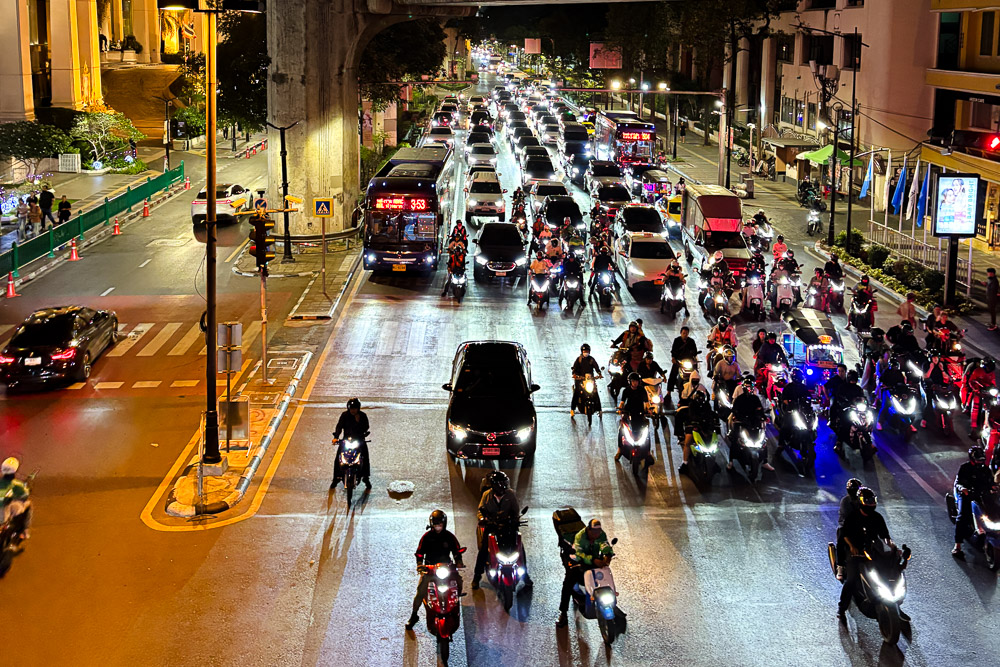
Why do we drive at such speed? Well, the first thing is the lack of law monitoring, and second, the traffic conditions and the red light. Congestion is our norm, and it is bad in Bangkok, bad enough for us to be ranked among the first in the world every year. It could take an hour trying to commute 3 kilometers somewhere in the city center, or easily a thirty-minute wait for a turn 500 meters ahead.
Our red light average cycle can be around 2 to 5 minutes long, and it is common for some to have up to 20 minutes of wait time. So no one wants to miss their opportunity to cross.
And why do we still drive? You may ask. The simple answer is probably for convenience. Being born and raised in a country where it is hot and humid all year round, people get tired of such heat. No one wants to wait for a bus after an 8-hour shift to go home, or arrive at a destination covered in sweat and foul body odor after a walk in the heat.
We do have a good sky train and metro system that covers a good part of the city; however, it is not even near being sufficient to cover a city like Bangkok, where there are places to go and things to see everywhere. If we have a choice of taking a car or a bike, anything longer than a 15-minute walk from the station could easily discourage us from walking to our destinations, 10 or even less if it is peak summer or midday in the sun.
Conslusion
Our driving culture, norms, failure to strictly adhere to laws and regulations, traffic conditions, and various other undiscussed reasons have led to an environment where it is not the best or safest for pedestrians. Changes for the better require time and effort, which is increasingly being addressed by our government to adhere to the international standard, as well as our people, who are becoming more and more vigilant. However, a change on such a scale will take time, as there are over 10 million registered vehicles in Bangkok alone.
This artical do not serves as an excuse, but an attempt to point out why. We do not intend to make it seem like people can get away with it just because it is how it is. We are trying to raise some awareness, and hope for the better.
For those who are travelling here for the first time, fear not, although our traffic conditions and road design may not be the best, our people will stop for you, and they will not be willingly running over you. With time and patience, along with some understanding and tips, you will be able to navigate Bangkok more safely upon your visit!
Be safe and enjoy your travel,
Travel Tegami