
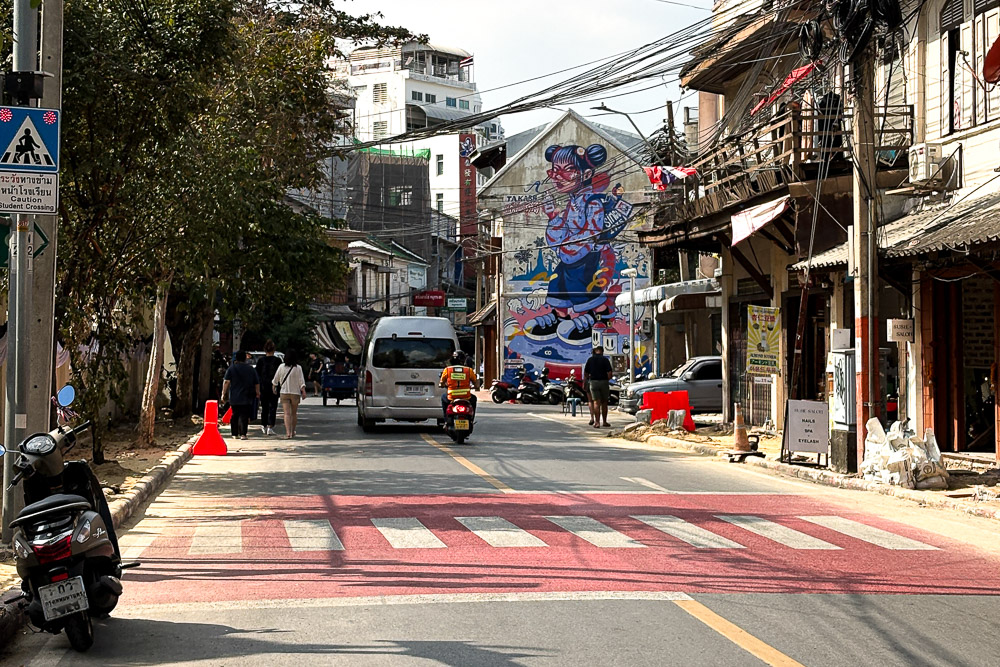
Seeing people getting annoyed and confused that no one is stopping, even at a pedestrian crossing, or standing for minutes trying to cross to the other side of the road, has become a classic in Bangkok as a daily commuter in the city. As locals, we will show you how we do it as safely as we can.
Quick Navigation:
Introduction
Although crossing the road in Bangkok is not as stressful as in countries like Vietnam, speaking from experience, it is certainly far from being completely stress-free.
Not fully knowing how to navigate the road crossing culture here is perfectly normal, even Thai people struggle sometimes, and we do have older and younger friends and family that also have very little to no idea of how to do it safely. In truth, there is no one way to do it right, but we will try our best to guide you!
A Real-Life Example
We will first walk you through how we would normally cross a road at a pedestrian crossing in Bangkok—how we approach it, what we look out for, and roughly how the situation tends to unfold. We will go into more detail later in the article with additional tips and things to be aware of.
If you come from a country where cars reliably stop before you begin crossing, we recommend reading on to get a clearer picture of how pedestrian crossings often work in Bangkok today.
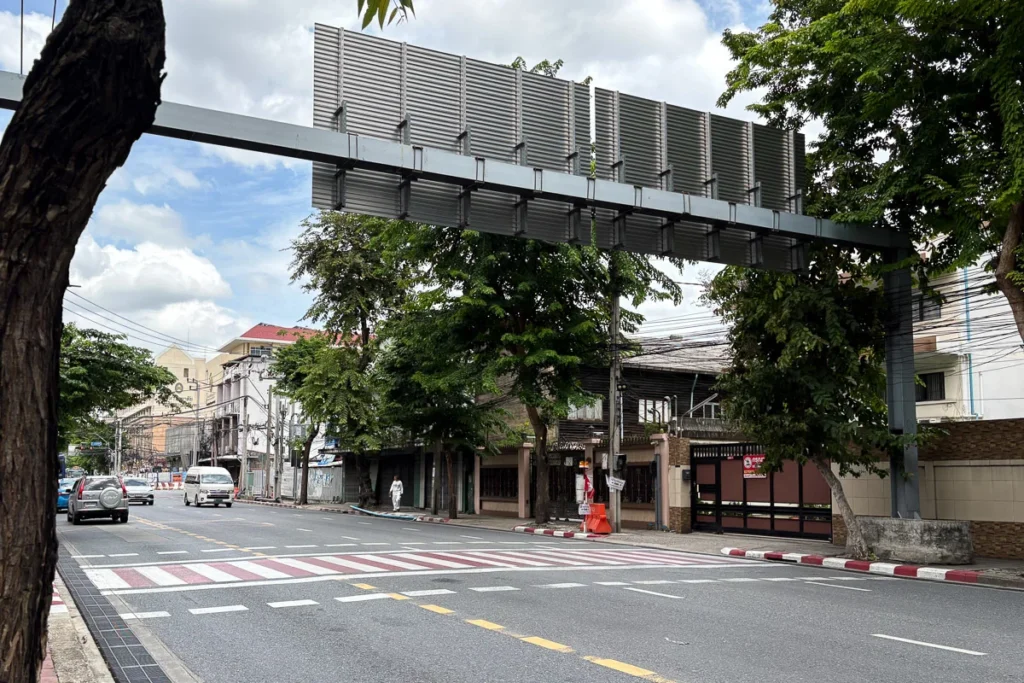
The scenario: A four-lane, two-way road with a small median or divider in the middle.
- The first thing is knowing when to start. We watch both cars and motorcycles carefully and wait for a sufficiently large gap in the first lane, or for vehicles to clearly slow down and stop. Sometimes this can take a while, so do not rush.
- Once it is clearly safe, we begin crossing the first lane slowly. Vehicles in the second lane will often start slowing down or stopping once they see you, but you should never assume that they will. Make sure you can clearly see that the vehicle has slowed or stopped before continuing.
- There are times when, even while you are already standing partway across the road, a car or motorcycle in the next lane may still pass in front of you. In that case, we simply wait for it to pass before continuing to the next lane and, in this example, stopping at the median.
- Once you reach the middle of the road, vehicles approaching from the other direction are often more likely to notice you and stop. Again, wait until you are certain it is safe before moving forward, treating each lane separately rather than assuming that because one car has stopped, the next lane is clear as well. Cars approaching from behind may sometimes overtake a stopped vehicle without immediately seeing the pedestrian crossing.
- Once every lane is clearly safe, we complete the crossing.
- Along the way, we may also raise one hand slightly as a signal to approaching drivers. When someone stops, many Thai people will give a small nod or bow in thanks—a very common gesture, even though drivers are legally required to stop for pedestrians at a crossing.
How many lanes do some local cross without a pedestrian crossing?
*Jaywalking is against the law, and we never recommend that you do it.
That said, to give you a rough idea of what you may see locals doing, this scenario generally applies only to alleyways, smaller roads, and local streets—not major roads.
1-3 lanes: This is what you will most commonly see people crossing without a pedestrian crossing. Locals do it frequently, especially in areas where the nearest designated crossing may be several hundred metres away.
A 4-lane crossing varies; This depends heavily on the road. Many four-lane roads are busy, with cars and motorcycles travelling at relatively high speeds. As locals, we would normally only even consider crossing on quieter secondary roads, and only when there is no pedestrian crossing reasonably nearby.
Even then, it is becoming less common for us to do so. We would generally only consider it on local roads where roadside parking reduces the actual moving traffic to around two lanes. Very occasionally, the same situation may apply to a six-lane road where parked cars effectively reduce it to four active lanes.
5-6 lanes and above: For us, this is simply a no. Roads of this size will usually have a pedestrian crossing, traffic light, footbridge, or another designated place to cross somewhere nearby. If you cannot find one, we recommend continuing until you do rather than attempting to cross the road directly.
A Basic Guide and tactic to Crossing The Road
Now, after identifying if you should cross or not, let us get into some tips we locals do.
Crossing at a pedestrian crossing, although the oncoming vehicles will likely not stop right away, is always a safer option, and the cars will eventually stop for you once you start walking.
There are two scenarios we look for before crossing:
- First is to look for a gap in traffic when the traffic is flowing.
- Second, when it starts stopping or slows down for the traffic light.
The First Scenario
For the first scenario, you will have to determine the gap and the speed of the approaching car. If it is wide enough and slow enough, here is what you can do:
Raise Your Hands while you slowly approach to Signal That you are Crossing
You do not have to raise it all the way like a Japanese kid at a pedestrian crossing. Just raise it halfway briefly to eye level to make your intention known, while also pretending like you are about to walk. It is imperative that you try to make eye contact with the oncoming car first.
Slowly Cross Lane-By-Lane
Crossing in sections, in many cases, the local will do this as the first lane you are approaching may be free of incoming cars. You start crossing to the first lane and wait until a car stops for you or passes by, determining that it is safe, before continuing on.
Most people will not immediately stop or even slow down at crosswalks. The RULE is to never expect them to stop. You must approach very cautiously and slowly advance, making sure that both cars and motorcycles see you and slow down or come to a complete stop.
They will likely stop once they see you cross, given the appropriate time to react in most situations.
Look for the Hazard Light
Cars will sometimes put on the hazard lights to signal you and the other cars of a crossing activity ahead. However, this does not mean the other lanes will surely stop! Approach slowly!
The second Scenario
Where the car is coming to a stop or slowing down.
*Always cross behind the car in front of you.
Be Aware of Motorcycles!
Motorcycles coming between cars in stopped traffic is also dangerous; be sure, even if you see all the cars already stopped in high traffic, sometimes there will be motorcycles that cannot see you in between the cars, so check every car you pass before advancing.
- In a very heavy two-way traffic coming to a stop, it is normal for locals to cross halfway first.
Simply stop on the line and wait for a wide gap where you can clearly see all the approaching vehicles, or, if the car sees you in the middle, it will have to stop for you; wait for it to do so before continuing to cross!
Useful Tips and Tricks on crossing road in Bangkok!
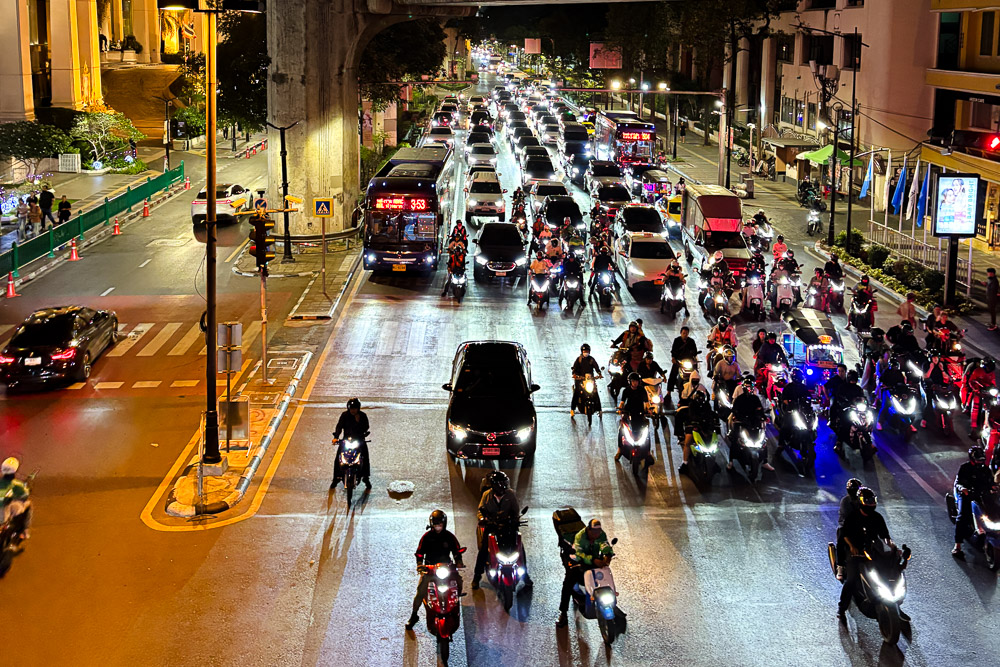
Try Signaling a Motorcycle Driver First
Many times, motorcycle drivers in the leftmost lane can be kinder to the people crossing.
If you really can’t find a good moment to begin crossing, make your intention known to them first, like raising your hand or making a faint attempt to start crossing, and try to make eye contact with one, as we mentioned before; there is a high chance they will start to stop and signal others to stop as well.
Personally, we find that we have a higher success rate doing it to motorcycle drivers, as you can often see more clearly if they are looking at you or not.
However, you must wait and also keep in mind the speed they are cruising, especially if cars are coming fast behind that may not be able to, or have the intention to, stop.
Other times, they may be the cause of many accidents, as a seemingly growing number of them do drives very fast and are not the first to stop. So, they are also what you have to always be careful of, especially once you are already in the middle of the road crossing.
Cross With BTS or MRT Stations or Skywalks
Ironically enough, the best tip for crossing the road in Bangkok is to avoid having to cross the actual road. Every BTS and MRT train station, both on the elevated platform and underground, will be connected on the other side of the road, sometimes available on multiple sides at an intersection.
The locals use it every day, simply walk up or down one of the staircases of a station, and come back up on the other side, safe and stress-free. Do not worry, they do not charge you money to do so, unless, in some cases, for MRT, the side you wish to cross to may be on the other side of the gate. In that case, the pedestrian crossing at the intersection should have a crossing light.
There are also elevated crossing platforms that go over some main roads; be sure to look for them.
Ask a Building Security for Help
There are a lot of security guards in front of buildings and condominiums, whose job is to help cars get in and out of the building. You may kindly ask them for help. In most cases, they will have a red flag pole in their hands or a glowing stick that can be used to signal for a stop.
Thai people are kind, and they will be willing to help you; sometimes they even do it without being asked to. In fact, you can see this happen often in residential streets where there are a lot of condominiums.
Note: Some hand gestures might be needed if they do not understand English, but most should be able to get the basic words. Kindly bow to them and say thank you, or even better, to tip them for it to make their day; they will not expect or demand money.
Follow the Local
An obvious one, but also an important one. Be patient and do not cross if the locals do not cross. Do not be the brave one; the local most likely knows best when you are safest to do so. If they wait, you wait.
The crossing light do work!
Sometimes the crossing signal will seemingly look like it is stuck on red forever, and you might start questioning if it is functioning properly.
They do! Traffic lights at some intersections are normally very long, sometimes lasting for longer than 10 minutes, which is why they can also affect your crossing signal. Wait for them to turn green before starting to cross.
Be Careful even when they turn green
You may think that it is common sense for a car turning left to stop for the pedestrian crossing when the light is green for the people walking, apparently, they are not for some people.
We have seen too many people just turn without looking at the people who are crossing. Regrettably, these behaviours are hard to fix, so the best counter is for you to be extra careful instead, for your own safety.
The Closing
We hope this article will help you on your trip to Bangkok, as we have often seen people struggling to cross the road here. Keep in mind that the tips and how-to guides are a mere basic guide to help you and not an instruction or the law, and you should always approach them with caution, while taking into consideration the unique scenario at the time you are crossing.
Now that you know how to cross the roads, let’s put it to use and explore cafes around Bangkok.
Be safe and enjoy your trip,
Travel Tegami